
PHOTO RIGHTS · IMAGE THEFT
Image Theft – A Photo Rights Attorney Explains the Cost of a Stolen Photo
Your photo appears on someone else’s website without a license. Or you’ve received a letter yourself because your site features an image for which someone is demanding payment. In both cases, the same questions arise: Who owns the image, what is the value of its use, and who bears the costs?
As attorneys specializing in photography law, we represent photographers, agencies, and companies nationwide.
★︎★︎★︎★︎★︎ 5 stars on Google · Over 5,000 cases since 2004
Known for:












WHAT IT’S ALL ABOUT
One photo, two pages, the same legal issue
Image theft means using a photo without the photographer’s or copyright holder’s permission. This happens in online stores, on blogs, on Instagram, in real estate listings, and on eBay. Often, there’s no malicious intent behind it. The image may have come from an agency, a supplier, or an image search. That doesn’t change the legal situation much.
Your photo will be used without a license
– You can demand that the use cease.
– You are entitled to damages, usually calculated as a notional license fee.
– If your name is missing, professional photographers often charge an additional fee.
You've received a claim regarding a photo
– Not every claim is valid, and not every claim is for the correct amount.
– If you pay or sign too hastily, you often tie yourself down for decades.
– If you don’t respond at all, you risk legal action.
What the Law Says About Image Theft
Every photo is protected. This applies to elaborately staged advertising photos just as much as it does to snapshots taken with a cell phone. Although the law distinguishes between a photographic work and a simple photograph (Section 72 of the German Copyright Act (UrhG)), this distinction is irrelevant when determining whether you may use someone else’s photo. In both cases, you need permission.
Typical examples from our practice include: a competitor’s product photo in your own online store, a press photo on your company blog, a portrait from a photo shoot that suddenly appears in an advertisement, or an image from a stock photo site whose license has long since expired. Even if you merely crop, flip, or apply a filter to someone else’s photo, you are still reusing it.
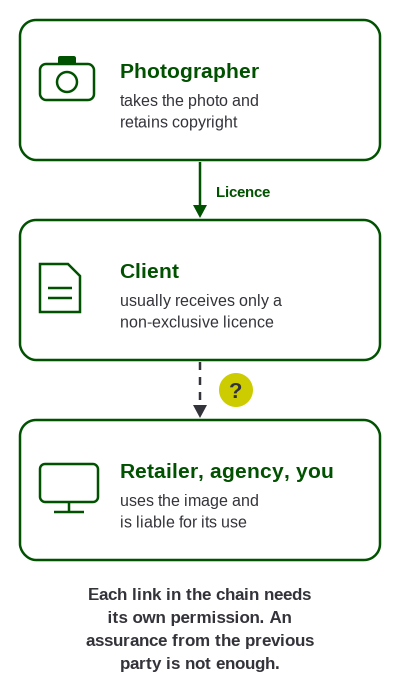
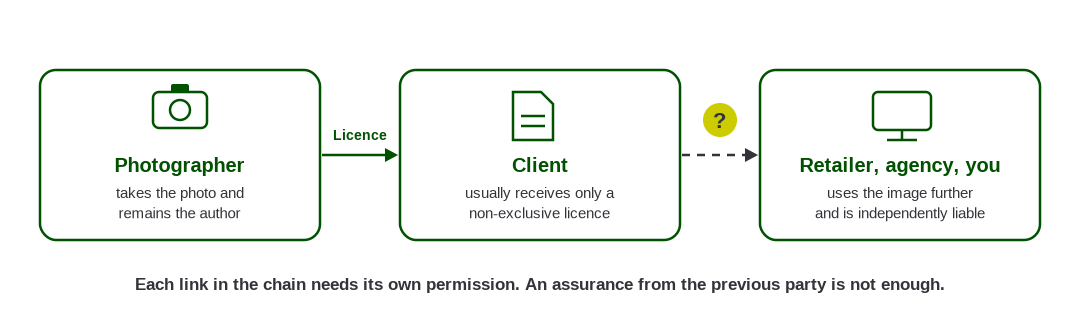
Equally important: Anyone using an image must verify for themselves whether they are permitted to do so. In 2026, the Higher Regional Court of Celle once again emphasized that this requires reviewing the entire chain of rights. A supplier’s or agency’s assurance that the image is “free” does not protect you from claims by the photographer.
§ 97(2) of the German Copyright Act (UrhG)
Right to Damages
§
“Anyone who commits the act intentionally or through negligence is obligated to compensate the injured party for the resulting damages. […] The claim for damages may also be calculated based on the amount that the infringer would have had to pay as reasonable compensation had he obtained permission to use the infringed right.”
IN PLAIN LANGUAGE
Anyone who uses a photo without permission and could have realized this must pay at least what a license would have cost. It doesn’t matter whether they would ever have purchased the license. Lawyers call this the “license analogy.”
How Much Does a Stolen Photo Cost?
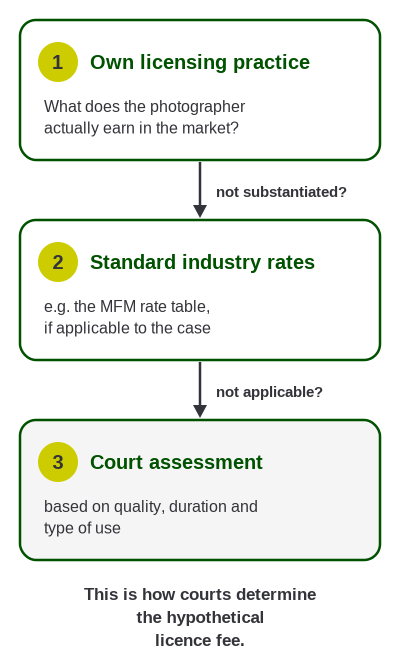
The courts ask what reasonable contracting parties would have agreed upon for this exact use. There is a set order for determining this. First, what the photographer actually receives on the market for comparable uses is taken into account. If the photographer does not have their own licensing practice, industry-standard rates are considered. If those are not available either, the court makes an estimate.
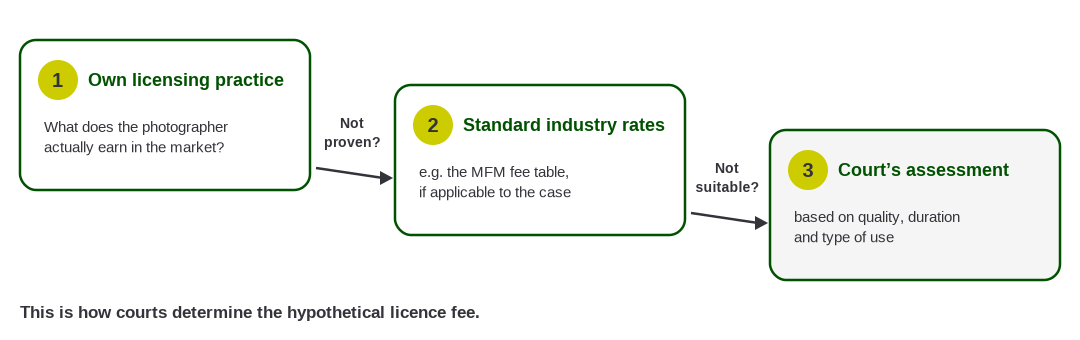
That’s why the amounts vary so widely. In our practice, we see claims ranging from €500 to €20,000. How much of that remains in the end depends on three factors: who took the photo, how it was used, and for how long.
There’s no upper limit when images are marketed commercially. In 2025, the Cologne Higher Regional Court awarded €34,732 because photos of the interior of Cologne Cathedral were offered for licensing in an image database without permission. That case concerned the rights of the owner, but the calculation was based on the same rules: What would a license for that exact use have cost?
Four figures from case law illustrate just how far apart a claim and the resulting award can be:
100 €
License for a snapshot of a sports car taken by an amateur photographer (BGH 2018)
107,14 €
Net amount per promotional photo taken by a professional photographer who does not operate his own licensing practice (Celle Higher Regional Court 2026)
100 %
Surcharge on the license if the professional photographer’s name is missing
10 years
The right to the fictitious license remains in effect for a long time, even after the statute of limitations has expired
AMOUNT OF DAMAGES
MFM Table: When It Applies and When It Doesn't
Almost every claim for image theft refers to the MFM table. This table is based on the image fees set by the Mittelstandsgemeinschaft Foto-Marketing, an annual overview of standard market rates for the use of photographs. The rates are often significantly higher than what courts ultimately award. The key factor is whether the table applies to your case at all.
The MFM table applies more when
– a professional photographer took the photo,
– he can prove that he actually licenses his images at those rates,
– the use falls under a category listed in the table, such as advertising on a company website.
The MFM table generally does not apply if
– the photo was taken by an amateur photographer,
– the photographer charges lower rates or cannot demonstrate any licensing experience,
– it is a simple snapshot or a basic product photo.
§
BGH, Urteil vom 13.09.2018 – I ZR 187/17
The snapshot is worth 100 €.
A company used a photo of a sports car on Facebook. It was not taken by a professional photographer. The Federal Court of Justice (BGH) rejected the MFM table because it does not serve as a useful basis for photos taken by non-professionals. Result: a €100 licensing fee and an additional €100 for the lack of attribution.
§
OLG Celle, Urteil vom 12.05.2026 – 13 U 88/25
Even professionals don't automatically get MFM
A professional photographer demanded payment at the MFM rates for four photos of a dance floor. Instead, the court based its decision on the fee he had charged for the original assignment: €107.14 net per image, doubled due to the lack of attribution. He had issued a cease-and-desist letter based on a value of €40,000. He was awarded €857.12 and was required to pay 85% of the litigation costs.
NOTE FOR PHOTOGRAPHERS
A well-organized, in-house price list and documented license sales are worth more than any spreadsheet.
NOTICE TO THOSE WHO HAVE RECEIVED A WARNING LETTER
A call for “MFM” is a starting point, not an end result.
Failure to Credit the Author: The Penalty
The photographer has a right to be credited for his or her photograph. If the name is missing, this can double the amount of damages. How often this actually happens depends on who took the photograph and what was agreed upon.
01
Professional Photographer
In such cases, the courts regularly award a 100% surcharge. The reason: Without credit, the photographer loses out on future assignments. This is how the Federal Court of Justice (BGH) ruled, and the Higher Regional Court of Celle confirmed it in 2026.
02
Amateur photographer
Those who do not make a living from photography generally do not lose any assignments simply because they are not credited. In 2026, the Dresden Higher Regional Court clarified that compensation is only considered if the loss of advertising value is specifically demonstrated.
03
Stock Photo
On many photo portals, photographers waive the right to be credited in the terms of use. The Federal Court of Justice (BGH) generally considers this permissible. In such cases, no additional fee is charged. It depends on the exact wording of the terms.
!
The name below the photo does not replace the license. And the license does not replace the name. Both are checked separately.
For more information, see our pages on attribution under Section 13 of the German Copyright Act (UrhG) and on damages under Section 97 of the German Copyright Act (UrhG).
Did you spot a claim on the table or a photo you took yourself?
During the initial consultation, starting at €250 plus VAT, we’ll assess your case and let you know what to expect.
Federal Court of Justice (BGH), Judgment of September 11, 2024 – I ZR 140/23 (“Coffee”)
Photo wallpaper: implied consent to standard photographs of the room. See also: I ZR 139/23 and I ZR 141/23.
Federal Court of Justice (BGH), Judgment of June 15, 2023 – I ZR 179/22 (“Microstock Portal”)
Waiving the requirement to credit the author in portal terms and conditions is generally permissible.
Federal Court of Justice (BGH), Judgment of September 1, 2022 – I ZR 108/20 (“Riptide II”)
Capping warning letter costs at a value in dispute of €1,000 is compatible with EU law.
Federal Court of Justice (BGH), Judgment of September 13, 2018 – I ZR 187/17 (“Sports Car Photo”)
No MFM table applies to photos taken by non-professionals; a €100 license fee plus €100 for failure to provide attribution.
Federal Court of Justice (BGH), Judgment of January 15, 2015 – I ZR 148/13 (“Motorcycle Parts”)
The statute of limitations runs separately for each day of use; residual damages as a fictitious license fee.
Federal Court of Justice (BGH), Judgment of September 18, 2014 – I ZR 76/13 (“CT-Paradies”)
The obligation to cease and desist includes removal and influencing third parties.
Higher Regional Court of Dresden, Order of August 13, 2026 – 4 U 508/26
No surcharge for failure to credit amateur photographers without demonstrated advertising value.
Higher Regional Court of Celle, Judgment of May 12, 2026 – 13 U 88/25
Review of the chain of rights; license based on the original fee rather than the MFM rate; 100% surcharge.
Higher Regional Court of Cologne, Judgment of May 23, 2025 – I-6 U 61/24 (“Cathedral Images”)
Licensing analogy when photos are offered in an image database without permission; €34,732 awarded.
Cologne Regional Court, Judgment of April 18, 2024 – 14 O 60/23
Amount in dispute for an injunction of €6,000 for a photograph; MFM table not applicable.
Higher Regional Court of Cologne, Order of November 22, 2011 – 6 W 256/11
Amount in dispute of €3,000 for simple photographs and private or small-scale commercial use.
PLATFORM LETTER
A letter from Copytrack, Pixsy, or a law firm
These days, many claims no longer come from the photographers themselves. Services like Copytrack or Pixsy use image recognition to scan the web for their clients’ photos. If they find an image without a recognizable license, they contact the website operator and demand proof of a license or payment. According to its own terms of service, Copytrack is operated by RD Legal GmbH, based in Berlin.
Such letters are neither automatically valid nor automatically invalid. Legally speaking, a payment demand from a service provider is different from a cease-and-desist letter from a law firm that includes a declaration of cessation and a deadline. What you’re dealing with determines your next step. There are always three questions to ask at the beginning:
1
Who is asserting their rights here?
The service provider is usually not the copyright holder itself. It acts on behalf of a photographer or an agency. It must be proven that this chain of ownership is valid.
2
Is there a license?
Images from stock photo sites, created by a web designer, or taken from an old template are often licensed, but no one can find the documentation anymore. Sometimes the license simply expired.
3
Is the amount correct?
The amount claimed is often based on standard rates that do not apply to the specific case. See above.
Silence isn’t a good response, and neither is paying without verifying the claim. You can find more information about cease-and-desist letters from attorneys on our page “Cease-and-Desist Letters in Copyright Law.”
Costs of a Cease-and-Desist Letter and Amount in Dispute
In addition to damages, almost every cease-and-desist letter includes attorney’s fees. These are based on the value in dispute—that is, on the estimated value of the photographer’s interest in obtaining an injunction. We regularly see cease-and-desist letters that set the value at €9,000 or €15,000 for a single photo. The courts often take a more realistic view.
3.000 €
A simple photo, a small frame
As early as 2011, the Cologne Higher Regional Court reduced the amount in dispute for simple photographs used for private or small-scale commercial purposes from €6,000 to €3,000.
6.000 €
Commercial Use of a Photo
The Federal Court of Justice (BGH) approved this amount in 2018 for a single photo on a Facebook page. The Regional Court of Cologne also set this amount in 2024.
1.000 €
Private individual, first warning letter
Individuals who have acted in a private capacity and not for professional purposes generally pay attorney’s fees only up to €1,000 (Section 97a(3) of the German Copyright Act (UrhG)). The Federal Court of Justice (BGH) confirmed this cap in 2022.
Anyone who sets the amount too high does so at their own risk. In the case heard by the Higher Regional Court of Celle, the photographer had issued a warning letter demanding €40,000 and ultimately had to pay most of the costs himself. We explain how warning letter costs are calculated on the page “Warning Letters: Costs and Amount in Dispute.”
What Our Clients Say
5,0
Verified Google Reviews


 Trustindex überprüft, ob die Originalquelle der Bewertung Google ist.
 Trustindex überprüft, ob die Originalquelle der Bewertung Google ist.
 Trustindex überprüft, ob die Originalquelle der Bewertung Google ist.
 Trustindex überprüft, ob die Originalquelle der Bewertung Google ist.
 Trustindex überprüft, ob die Originalquelle der Bewertung Google ist.
 Trustindex überprüft, ob die Originalquelle der Bewertung Google ist.
 Trustindex überprüft, ob die Originalquelle der Bewertung Google ist.
 Trustindex überprüft, ob die Originalquelle der Bewertung Google ist.
 Trustindex überprüft, ob die Originalquelle der Bewertung Google ist.
 Trustindex überprüft, ob die Originalquelle der Bewertung Google ist.
The work really begins after the cease-and-desist letter
Many people sign the attached cease-and-desist letter, remove the image from their homepage, and consider the matter settled. This is exactly where the costly cases arise. Anyone who agrees to cease and desist must completely remedy the unlawful situation. The Federal Court of Justice (BGH) also requires that you take action against third parties to the extent that you have influence over them.
In the case in question, a seller had ended his eBay listings. The photos remained accessible via the search for ended listings. The photographer calculated 54 infringements at €5,100 each.
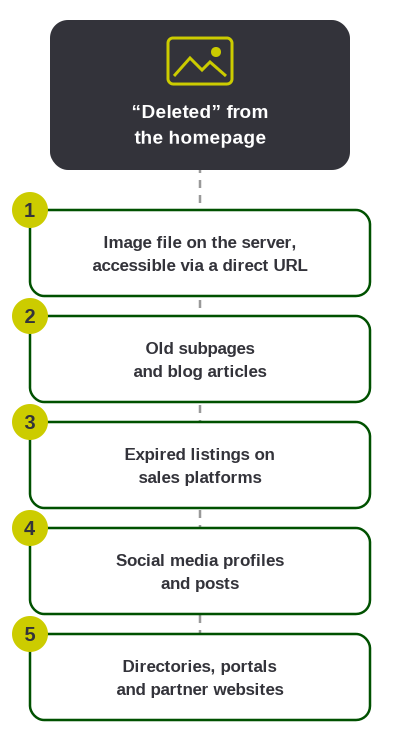
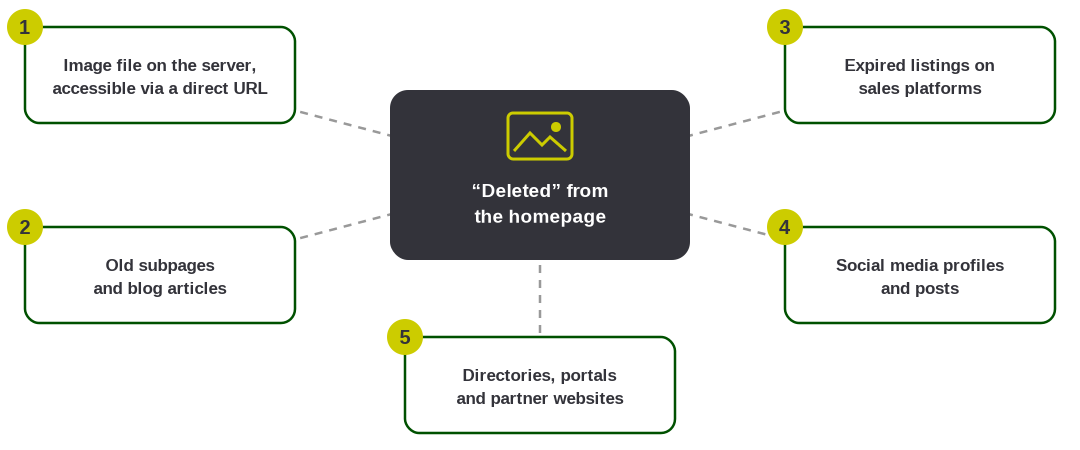
Therefore, you must also check the server, old subpages, image files at their direct URLs, sales platforms, social media profiles, and directories.
We explain whether and in what form you should sign on the page regarding the cease-and-desist declaration subject to a penalty clause.
!
A cease-and-desist declaration is generally valid for life. Read it as you would read a contract that binds you for 30 years.
DEADLINE
Statute of limitations: three years, but not for everything
Claims for image theft generally become time-barred after three years. The statute of limitations begins at the end of the year in which the photographer learned of the use and the user. Two special circumstances make the calculation more complicated than it sounds.
●
Start of Use
The photo is posted online. The deadline hasn’t started yet for the photographer as long as he doesn’t know about it.
●
Every day counts on its own
According to the Federal Court of Justice (BGH), if the image remains online permanently, a separate period begins for each day it is used.
●
Three years
The statute of limitations begins at the end of the year in which the photographer becomes aware of the matter.
●
Ten years
The photographer may still demand payment for the deemed license, including the surcharge, for this period after the statute of limitations has expired.
NOTE FOR PHOTOGRAPHERS
Even old cases can still be worth money. Reliable evidence showing how long the image has been online.
NOTICE TO THOSE WHO HAVE RECEIVED A WARNING LETTER
An image that has been sitting online unnoticed for years is not a closed issue.
"I did get the picture after all."
The most common objection after receiving a cease-and-desist letter is: “The photo came from someone else, so I was allowed to use it.” Sometimes that’s true, but often it isn’t. Three scenarios from case law illustrate where the line is drawn.
Images from the manufacturer or supplier
A retailer used product photos he had received from his supplier. However, the photographer had granted the supplier only a simple right of use, not permission to redistribute the photos. The retailer was held liable.
The photo wallpaper on the wall
Anyone who takes a photo of a room with photo wallpaper and posts the image online is not infringing any rights. The Federal Court of Justice (BGH) considers this a customary use that anyone selling their photo as wallpaper must expect.
The stock photo from back then
Licenses from stock photo sites are often limited in duration or restricted to specific uses. If you cancel your account, switch agencies, or use the image in an advertisement instead of on a blog, you may be using it without a license.
§
BGH, Urteil vom 11.09.2024 – I ZR 140/23 („Coffee“)
What is customary is considered permissible
A photo wallpaper featuring a coffee cup was hanging in the guest area of a tennis center. The agency that built the website displayed the room online as a reference. The Federal Court of Justice (BGH) dismissed the lawsuit: Anyone who distributes a photo as wallpaper without a copyright notice tacitly consents to such use, including by service providers and real estate agents. There was also no claim based on a lack of attribution.
The rights a photographer has granted in a specific case depend on the contract. You can read about how usage rights are handled for photo shoots on our page about TFP contracts.
PROCEDURE
Here's How We'll Handle Your Case
1
Preserve evidence
Screenshots with the date and address, the other party’s letter, invoices, license documents, and original files. Before anything is deleted.
2
Clarify the chain of custody
Who took the photo, who was granted what rights, and who provided the image on the page?
3
Determine the amount
We determine what damages and costs are realistic based on current case law.
4
Assert or Defend
Cease-and-desist letters, negotiations, settlements, or lawsuits. For photographers and those who have received cease-and-desist letters, both out of court and in court.
Initial consultation starting at €250 plus VAT. During a no-obligation initial consultation, we’ll determine whether we can take on your case and what the consultation will cost.
Frequently Asked Questions
Yes. While such a letter is not yet a lawsuit, it does indicate that someone is asserting rights to an image. Those who do not respond often receive reminders and, subsequently, correspondence from a law firm. Responding does not mean paying. It means having the validity of the claim and the amount verified and then responding in a targeted manner.
That depends on the photo, the photographer, and the intended use. The courts have awarded €100 for a snapshot taken by an amateur photographer and approximately €107 net for a promotional photo taken by a professional photographer—in each case, the amount was doubled due to the lack of attribution. In cases of intensive commercial use of multiple images, the amounts can reach five figures. On top of that, there are the attorney’s fees associated with the cease-and-desist letter.
Only if it applies to your case. The Federal Court of Justice (BGH) has rejected this argument for photos taken by non-professionals. Even a professional photographer must demonstrate that he actually commands such fees in the market.
No. Deleting the content terminates future use. The right to claim damages for past actions remains, and without a cease-and-desist declaration, the right to seek an injunction also continues. Nevertheless, you should secure evidence before deleting the content.
Generally, three years from the end of the year in which he became aware of the use. He may also claim the deemed license for up to ten years.
Yes. Just because an image appears in a search engine doesn’t mean you have permission to use it on your own website. The same applies to images without watermarks and to images that don’t have a name attached to them.
The initial consultation starts at €250 plus VAT; the review of letters and documents starts at €500 plus VAT. During a no-obligation initial consultation, we’ll determine whether we can take on your case and what the consultation will cost.
Both. We enforce claims on behalf of photographers and agencies and defend companies, stores, and self-employed individuals against claims. That’s why we understand the arguments on both sides.
Your Contacts
Your Team for Questions About Image Theft
REHKATSCH RECHTSANWÄLTE advises photographers, agencies, creators, online stores, and companies on copyright and photography law. Two specialized attorneys and our back-office team will handle your case.
Patrick Rehkatsch
Attorney Specializing in Copyright and Media Law – Founder
Attorney
Specializing in
Copyright and Media Law
Juliette Sarvan de Castro
Attorney Specializing in Copyright and Media Law
Contact
How to Reach Us
Choose the option that works best for you—we’ll get back to you quickly.
Schedule an appointment
Right in our calendar – choose your preferred date
What'sApp
Quick Questions, Quick Answers
Phone
Available directly Mon–Fri
Write to us about what's on your mind