
Your Lawyer for AI Content Labelling Requirements
From August 2, 2026, new AI content labelling requirements apply across the EU. Find out when AI-generated content must be labelled and what businesses, creators, and agencies need to do.
BASICS
AI Disclosure Requirement: What Takes Effect on August 2
The AI Regulation is the world’s first AI law. It governs how companies develop AI and how users may use it—based on the risk associated with each application. It has been in effect since 2024, but the individual requirements are being phased in gradually.
The Next Major Deadline
Do you use AI and publish AI-generated content? If so, you’ll need to label it starting on this date. Exactly what’s covered by this requirement depends on the content—we’ll explain it for you.
2, 2026
The AI Regulation in 60 Seconds
Patrick Rehkatsch explains what the AI Regulation is, why it is tiered by risk, and why August 2 could be a crucial date for you.
The first risk isn't the fine—it's the warning letter
You read about fines running into the millions everywhere. For most companies, however, that’s not the primary risk. The practically more dangerous lever: the cease-and-desist letter. The labeling requirements under Article 50 are likely to be considered rules of market conduct. This means that a competitor or an association can issue a warning under competition law for a lack of AI labeling—starting from day one, without any government agency even having to take action.
Patrick Rehkatsch explains what the AI Regulation is, why it is tiered by risk, and why August 2 could be a crucial date for you.
Video to follow
A Warning Letter Instead of a Fine—The Real Risk
Why a cease-and-desist letter from a competitor is practically more dangerous than a hefty fine from the authorities—and what you can do about it.
Act Now
AI Labeling Requirement: Are You Prepared?
Anyone who posts AI-generated content must label it starting August 2—otherwise, they risk receiving a warning. In our AI Act series, we’ll show you what applies to you now.
Art. 50 AI Regulation
Provider or operator—which are you?
One term is currently causing some confusion: the “operator.” Article 50 of the AI Act divides transparency obligations into two roles—some obligations apply to the provider, while others apply to the operator. As a result, the regulation affects not only OpenAI and Google, but also a great many companies, businesses, and content creators.
Provider
Develops the AI system or brings it to market. Typically: the major AI providers, but also companies that release their own tools.
Operator (Deployer)
Uses the AI system for professional purposes. If a company uses AI for social media posts or advertising, or if an influencer uses AI for videos, they are generally considered operators.
Your Team for Questions About AI Labeling Requirements
Attorney
Juliette Sarvan de Castro
Attorney
Patrick Rehkatsch
"Experienced. Strategic. Assertive.
We solve your legal challenges."
LABELING
The three official EU icons for AI content
There are three official icons you can use to label AI-generated content. The key question is always the same: Was AI involved? Did it create everything, or did it modify something that already existed?

1. Basic
AI was used in the creation process, but not everything was generated by AI. For example: a video in which only the voice was created using AI.
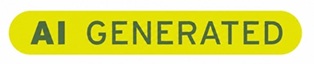
2. Entirely AI-generated
All of the content is generated by AI; no one else was involved. Example: an image, video, or text generated entirely by AI.
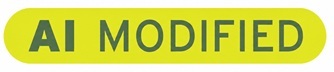
3. AI-processed
Something real has been altered using AI—a real photo or video. Example: a swapped face or a digitally furnished room.
Deepfakes and Real People
A deepfake isn't just an AI-generated image or video. A deepfake always depicts a real person or a real event—only it's faked, and so convincingly that it's almost impossible to tell. Anyone who publishes something like this must label it as such.
Face Swap and AI Avatars
If you superimpose a stranger’s face onto your video or put words in someone’s mouth, that’s a deepfake. A clearly fictional avatar is not subject to these requirements—but if it realistically mimics a real person, it must be labeled as such.
Cloned Voices
If you clone a real person's voice, it quickly becomes an audio deepfake. For audio-only content, the disclaimer should be spoken—briefly and clearly—right at the beginning. If a video is included, a visible disclaimer is also required.
AI Backgrounds and Green Screen
An obviously artificial background isn't a problem. A photorealistic AI-generated background, however, that looks like a real place and gives the impression that the photo was taken there can become a deepfake.
The Rule of Thumb
Can everyone tell right away that the scene is staged? If so, that's fine. Could it be mistaken for the real thing? If so, label it. The greater the potential for deception, the clearer the label must be.
Four short videos on the topic of deepfakes
Video to follow
Video to follow
Video to follow
Video to follow
Contact
How to Reach Us
Choose the option that works best for you—we'll get back to you quickly.
Book an appointment
Right in our calendar – choose your preferred date
What'sApp
Quick Questions, Quick Answers
Phone
Available directly Mon–Fri
Write to us about what's on your mind
Processing or Labeling Requirement?
Add a beauty filter, smooth out the skin—is that already a deepfake? Usually not. A standard filter or AI editing—such as subtitles, noise reduction, color correction, or stabilization—is considered normal editing and does not trigger a labeling requirement.
And what about AI-generated text?
A text written with ChatGPT does not automatically have to include an AI disclaimer. This primarily applies to published texts that inform the public about topics of public interest—such as an automated news post rather than your internal email. And even then, there’s an exception: if a human has fact-checked the text and a named individual bears editorial responsibility.
Who is liable within a company?
An employee posts an unverified AI-generated text on the company’s account—who is liable? The party responsible is whoever uses the AI in a professional capacity and publishes the content: the company. If there is no clear policy regarding who reviews the content and who is responsible, the company may also be held liable for organizational negligence. A brief internal AI policy can prevent this.
Four Videos on Delimitation
Video to follow
Video to follow
Video to follow
Video to follow
Proper Labeling - Where and How
Is “created with AI” at the bottom of the caption enough? Often not. The disclosure must be visible at first glance—not just in the credits and not hidden in the caption, which many people don’t even click to expand.
Right in the picture
The safest place to put the note is right on the first visible image, in an uncluttered, high-contrast corner—but not all the way at the bottom or on the right, where the platform buttons would cover it.
Visible long enough
There’s no legally mandated number of seconds—just make sure it’s clear and long enough to read. For AI videos that look completely realistic throughout, it’s also a good idea to include a small duration label—people tend to jump right in.
A platform switch isn't enough
The platform label and legal disclosure are two separate checks. If someone uploads the video elsewhere, the platform label disappears—but your note in the image remains.
Two videos on practical implementation
Video to follow
Video to follow
Set up your AI labeling in compliance with the law—we're here to help.
Do you post AI-generated content, produce ads using AI, or want to develop an internal AI policy? During a no-obligation initial consultation, we’ll take a look at your specific situation—without legal jargon and without any time pressure.
The 5-Question Checklist: Do You Need to Label It?
AI was involved—but does that mean your content needs to be labeled? Go through these five questions. The more times you answer “yes,” the more likely you’ll need to label it.
1. Did AI generate or actually alter the content? Or did it merely provide support—for example, with editing or subtitles?
2. Is it an image, audio, or video that could appear real? The more realistic the format, the more likely the obligation applies.
3. Does it resemble real or plausibly real people, places, or events? If so, we’re quickly dealing with a deepfake.
4. Is it a published text on a topic of public interest? Internal emails are different from an automated news post.
5. Was there genuine human review and a person in charge? Only then does the exception for editorially reviewed texts apply.
Video to follow
The 5-Question Checklist in the Video
Patrick Rehkatsch walks you through the five questions—so you can tell in under a minute whether your content is subject to the labeling requirement.
Individual cases often come down to the details. If you're unsure whether your content falls under this requirement, we'll review your specific case.
Frequently Asked Questions About the AI Labeling Requirement
The transparency requirements under Article 50 of the AI Regulation will take effect on August 2, 2026. Although the Regulation itself has been in force since 2024, the individual requirements will take effect on a phased basis.
Most likely, yes, if you use AI in a professional capacity. Article 50 distinguishes between providers who develop AI and operators who use AI in a professional capacity. Anyone who uses AI to create social media content, advertisements, or text is generally considered an operator.
Often not. The notice must be visible upon first contact, not only after expanding the caption or in the credits. A visible label directly in the image is a safer option.
Not necessarily. The platform label and legal disclosure are two separate checks. If the video is uploaded elsewhere, the platform label disappears, but a note remains in the image.
Usually not. Standard editing, such as color correction, subtitles, or a beauty filter, generally does not trigger a labeling requirement. The key factor is not the tool itself, but whether the content could be misleading.
No, not automatically. This primarily applies to published texts that inform the public about topics of public interest. There is also an exception for cases involving genuine human review with clearly defined responsibility.
A lot is written about fines, but the more immediate risk is receiving a warning letter under competition law from competitors or industry associations. This can result in immediate financial costs without any government agency taking action.
No. The label only fulfills the transparency requirement. If you depict a real person, you also need that person’s consent and must respect their privacy and image rights.