
Attorney specializing in price advertising & misleading price claims
"Instead of €199," "only €1," "up to 70% off," "free with purchase": These kinds of claims sell—and are the most common reason for cease-and-desist letters sent to online stores, brands, startups, and creators. We review your price advertising before a competitor does.
On this page
What Misleading Price Advertising Is All About
Price is the first thing your customers look at—and that’s exactly why it’s the most closely scrutinized element of advertising in all of marketing.
In principle, you are free to set your own prices. You may set, raise, or lower prices at your discretion and even calculate them differently by region. Whether a price corresponds to the “objective market value” is legally irrelevant. What you are not allowed to do, however, is mislead customers about the price.
Competition law requires price accuracy and clarity. As soon as you state a price, it must be correct—specifically, as an average customer would understand it. A price advertisement is misleading if the target audience perceives a price or a price advantage that does not actually exist. It does not matter whether you intended to deceive. It is sufficient that the advertisement objectively creates a false impression and is likely to influence a purchasing decision.
This is precisely where the risk lies: price advertising only works if it suggests an advantage—and a suggested advantage that has no legal basis is misleading. Often, there is only a fine line between effective advertising and a violation warranting a cease-and-desist letter.
Strikethrough prices – a classic
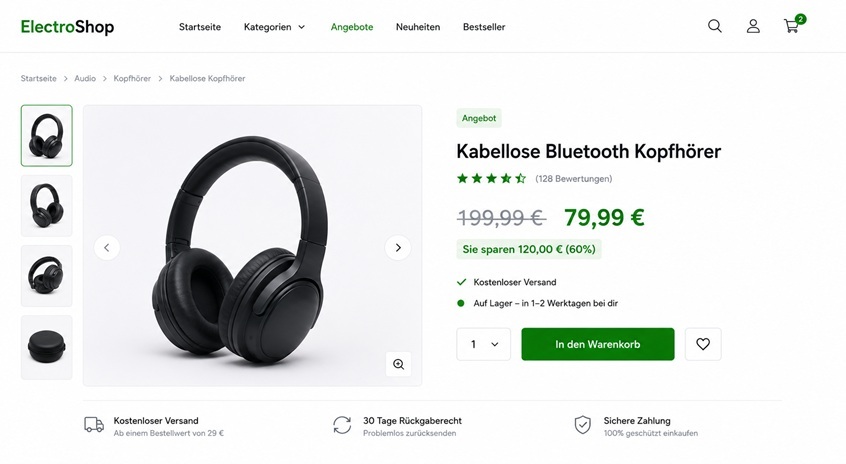
The crossed-out price next to the current price is the most popular advertising tool in e-commerce—and by far the one most frequently criticized. The reason: Anyone who displays a strikethrough price is claiming that the crossed-out amount is the previous, higher, actual retail price. If that is not true, the advertisement is misleading.
An advertisement featuring a price reduction must clearly indicate what the crossed-out price refers to: your own previous price, the manufacturer’s recommended price, or a standard market price. And the comparison must come from the same sales channel—you cannot simply compare an online price with the previous in-store price as the crossed-out price.
The 30-day rule for price reductions
Anyone advertising a price reduction must use as a reference point the lowest price that was in effect during the 30 days prior to the reduction. If you contrast your reduced price with a crossed-out reference price that was not in effect during that time frame, this is not only misleading—it also violates the Price Indication Regulation. Two grounds for legal action stemming from a single incorrect strikethrough price: that’s what makes these cases so attractive to those issuing cease-and-desist letters.
Practical tip: The real challenge lies in figuring out exactly how to implement the 30-day rule properly in your shop system—especially when it comes to ongoing discounts, flash sales, and automated repricing tools—and that’s exactly why we’d love to consult with you before you launch your campaign.
Exorbitant prices & price gouging
A "moon price" is a price that is so far above a seriously calculated or market-standard level that it is merely a fantasy figure—set artificially high only to be drastically crossed out shortly thereafter. Anyone who systematically raises and lowers prices to feign an advantage is engaging in improper price gouging. The earlier higher price must have been charged in good faith and for a reasonable period of time.
How long can the old price remain "struck through"?
If the new, lower price has long since become the standard price, continuing to display the crossed-out price gives the false impression that a promotion is still in effect when it is no longer available. How long this side-by-side comparison remains permissible depends on the product. As a guideline from case law: For everyday goods, one week may be sufficient; for fashion, two weekends; for large appliances and vehicles, around two months; and for durable goods, in some cases up to six months. Three months have already been deemed too long for a new price that has been in effect for some time.
Comparison with RRP and list prices
The manufacturer's suggested retail price is a strong selling point—and a common reason for receiving a cease-and-desist letter. An MSRP may only serve as a reference if it actually exists, is genuinely intended as a recommendation, and is still current during the period in question. If you advertise using an MSRP that the manufacturer has long since discontinued or that never existed, that is misleading.
The same applies to “list prices,” “catalog prices,” or “regular prices”: The advertisement must make it clear what the comparison refers to, and the price stated must not deviate from the underlying list. A reference that merely creates the appearance of a particularly favorable individual offer, even though lower prices are available anyway, is not permitted.
Not sure about your RRP or discount promotions?
We review marked-down prices, MSRP comparisons, and discounts before they go live.
"Free," "no charge," "€0" -a dangerous promise
There’s no such thing as “a little bit free.” Anyone who advertises using terms like “free,” “gratis,” “at no cost,” or “at no charge” cannot charge any fees afterward—not even small ones. And here’s the catch: a footnote won’t save you in this case. A footnote that qualifies the “free” claim reverses the statement into its opposite and is therefore impermissible.
If you falsely advertise to consumers using “free” or “at no cost,” a per se prohibition from the Annex to the UWG applies—meaning a ban without any consideration of the individual case. There are many practical pitfalls: hidden shipping costs only waived after a minimum order value despite advertising “free shipping,” “€0” plans with costs initially charged but later refunded, or software that is supposed to be “free” to use but for which a license fee becomes due after a certain period.
Closely related to this is cross-subsidization: If a product is advertised as a “gift” or for €1, while the cost is actually recouped through a bundled contract, it depends on whether the public recognizes this. And finally, advertising with obvious facts: If you highlight something as an advantage that is required by law anyway or is completely standard practice, that is also misleading.
Contact
How to reach us
Choose the option that works best for you—we'll get back to you quickly.
Book an appointment
Right in our calendar – select your preferred date
What'sApp
Quick questions, quick answers
Phone
Available directly Mon–Fri
Let us know what's on your mind
Bait-and-switch offers & "starting at" prices
A "bait-and-switch" offer occurs when a single, conspicuously low-priced item gives the impression that the entire product range is similarly inexpensive—or when the advertised product is, in reality, barely available. "Starting at" prices and "from … to …" ranges are generally permitted, as long as they convey a realistic picture and the product advertised as particularly inexpensive is actually available in reasonable quantities. If you advertise with "starting at €1" and clicking on the ad leads to a page where this offer isn’t immediately visible, the ad is no longer permissible.
Prices on the Internet & Price Comparison Sites
Online, customers expect the price displayed to be up to date. If the price shown online—for example, on a price comparison site—is even just a few hours lower than the price you actually charge, that is already considered misleading. And crucially: You must accept responsibility for this discrepancy as your own action, even if it arises through a comparison site.
Descriptive price labels: "Saver price," "Crazy price," "Bargain"
Even if the price listed is completely accurate, the way you interpret it can be misleading. Terms like "savings price," "special price," "super price," "bargain," or "crazy price" suggest a price advantage. If this advantage does not objectively exist—for example, because it is your standard regular price—your own assessment becomes the problem.
Your team for questions about price advertising
Attorney
Juliette Sarvan de Castro
Attorney
Patrick Rehkatsch
"Experienced. Strategic. Assertive.
We solve your legal challenges."
Attorney
Juliette Sarvan de Castro
Attorney
Patrick Rehkatsch
"Experienced. Strategic. Assertive.
We solve your legal challenges."
Bundled offers, eye-catching deals, and price guarantee
If you bundle multiple services into a single offer—such as a device plus a contract—you may not hide the less favorable price components in the fine print while the more attractive part is prominently displayed. If individual price components are listed, the Price Indication Regulation requires that the remaining components also be disclosed, including the minimum contract term. Explanatory asterisk notes are permitted—but only if the explanation is easily accessible and not graphically buried in such a way that it is overlooked.
Price Guarantee & Best Price Advertising
"Best price in town" or a "lowest price guarantee" is a unique selling point related to price—and therefore requires explanation. It becomes misleading if the conditions for the promised refund are practically impossible to meet, if you could easily have determined that your price isn’t the lowest, or if you’re the exclusive seller of the product—in which case the “lowest price” goes without saying.
Who is liable—and how much does a cease-and-desist letter cost?
Under competition law, the person responsible for the advertising is liable—and this includes situations in which an incorrect price is made public via a price comparison engine or a linked portal. A cease-and-desist letter typically requires a declaration of discontinuance subject to a penalty clause, reimbursement of the opposing party’s attorney’s fees, and a contractual penalty for each future violation. Anyone who signs a cease-and-desist declaration that is too broad often binds themselves for years—and a single overlooked strike-through price in the shop can then become costly.
In unfair competition law matters, the value in dispute is generally set at a minimum of EUR 25,000. Consequently, the legal fees for issuing a cease-and-desist letter are typically just under EUR 1,500.
Important: Whether a cease-and-desist letter is justified, whether the requested declaration of discontinuance goes too far, and which response will minimize the resulting costs can only be determined with certainty after reviewing the specific letter. Don’t react too hastily—but don’t wait too long either: In competition law, short deadlines and preliminary injunctions are common.
Who this is particularly relevant for
Price advertising affects almost everyone who sells something—but certain groups are particularly targeted:
E-Commerce & Online-Shops
Markdown prices, the 30-day rule, base price disclosures, and shipping costs—these are the main areas where warnings are issued across Shopify, Amazon, eBay, and independent online stores.
Fashion-Brands
Permanent "Sale" labels, "up to X%" discounts, and comparisons to the MSRP are ubiquitous in the fashion industry—and a prime target.
Startups
Pricing and discount logic is often built into the product before it has been reviewed by legal counsel. Setting things up properly from the start is more cost-effective than making corrections later on.
Influencer & Creator
Discount codes, "free" promotions, and affiliate deals combine price advertising with promotional labeling—two areas prone to legal warnings at once.
Producers, Music & Film
Bundles, presale and introductory prices, as well as ticket and merchandise promotions, must deliver on their promises.
AI & Tech Providers
"Free" plans, freemium models, and trial periods that later require payment are a growing source of controversy.
- Here's how REHKATSCH Law Firm can help you
- Review of Your Price Advertising
– Clearance prices, MSRP comparisons, discounts, "starting at" prices, and "free" claims before they go live.
- Defending Against Cease-and-Desist Letters
– Review of the letter, modification or rejection of the cease-and-desist letter, and representation in summary proceedings.
- Taking action against competitors
– when a competitor distorts your market with improper pricing practices.
- Store & Campaign Setup
– Legally compliant implementation of the 30-day rule, the Price Indication Regulation, and the design of asterisk disclosures.
Frequently Asked Questions About Price Advertising
Am I even allowed to advertise with crossed-out prices?
Yes. Strikethrough prices are generally permitted—as long as the crossed-out price is a genuine price that was previously offered in good faith, the context is clear, and the guidelines for price reductions are followed.
What is the 30-day rule?
Anyone announcing a price reduction must base it on the lowest price over the previous 30 days. A reference price that was not in effect during that time period is both misleading and a violation of the Price Indication Regulation.
My offer is "free"—why could I receive a warning for that?
Because "free" is taken literally. If there are costs involved—no matter how small—the advertisement is misleading, and an asterisk doesn't fix that.
I received a warning letter regarding price advertising. What should I do?
Do not sign without reviewing the document first. Keep an eye on the deadline and have a lawyer review the letter as soon as possible—the cease-and-desist letter is often too broad in scope.
Does that also apply to Amazon, eBay, or Shopify?
Yes. The requirements apply regardless of the platform—and you are also responsible for any price information that is made public through price comparison sites or portals.
Can I advertise using "Sale" or a crossed-out price on a permanent basis?
Only to a limited extent. If the reduced price has long since become your standard price, continuing to display the strikethrough price gives the impression of a promotion that no longer exists—how long this comparison remains effective depends on the product.
Secure your price promotion
Whether you're planning a campaign or have already received a warning letter: let's take a look at it right away. During a no-obligation initial consultation, we'll assess your situation and outline the next steps.