

Fashion Workers Act New York: New protections for models and agencies starting in 2025
The Fashion Workers Act in New York marks a significant turning point for the rights of models and their management. From June and December 2025, strict regulations will apply to agencies, customers, and clients in the fashion capital—with the aim of creating fair conditions, greater transparency, and protection against exploitation.
Particularly noteworthy: issues such as overtime, AI-generated replicas (digital twins), and exclusive contracts will also be regulated. Find out exactly what is changing and why the law deserves international attention here.
Why is there a new law?
The fashion industry in New York is huge – but until now, models there have had little legal protection. Unclear contracts, late payments, excessive commissions, and abusive digital use were not uncommon. Activists such as Sara Ziff (Model Alliance) drew attention to these abuses.
The „Fashion Workers Act“ (Article 36 of the New York Labor Law) is the response to this – initiated by the New York Senate, supported by the Model Alliance and passd in 2023.
Who is affected?
The law applies to:
Models: regardless of gender or status (freelance or employed)
Modeling agencies: all agencies or management companies
Clients: brands, photographers, agencies that book models
Technology companies: when digital replicas of models are used (e.g., AI-generated)

What's new? An overview of the most important changes
Deal memos become mandatory
A written deal memo must be in place before each job. It contains:
Name of the client & job description
Fee & payment deadline
Any costs (travel, accommodation)
Rights of use (e.g., social media, posters, print)
No Deal Memo → no job!
Clear commission limits
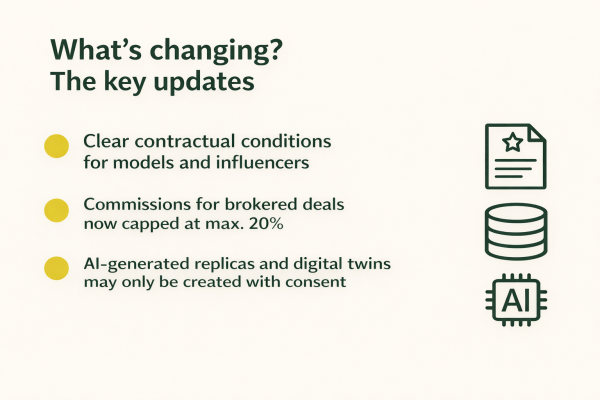
Model agencies will be allowed to retain a maximum of 20% commission in future. Additional fees – e.g. for “administration,” scouting, or placement – are prohibited.
Exclusive contracts are limited
Exclusive contracts may only run for a maximum of 3 years. Automatic renewal is not permitted – this protects models from excessive dependence.
Digital replicas? Only with consent!
The legislator protects the personal rights of models – including digitally. Anyone who wants to use a digital image (AI replica) of a model needs:
separate, written consent
precise details of the planned use (e.g., duration, medium)
the option to revoke consent
Old clauses or general “image rights” assignments are no longer valid for this purpose.
Power of attorney: Only voluntary
Agencies may no longer demand mandatory power of attorney to represent models, e.g., in matters of payment, bookings, or digital issues. This must be granted voluntarily and be revocable at any time.
Overtime & surcharges
Working more than eight hours a day? Then there is a 50% surcharge on the fee – unless a flat daily fee has been agreed.
Registration requirement from December 2025
From December 21, 2025, all modeling agencies must register with the New York State Department of Labor.
Fee: $500–700 (depending on company size)
Large agencies: additional security deposit (e.g., $50,000)
Registration is valid for 2 years, renewal required at least 90 days in advance
Unregistered agencies risk fines (up to $5,000 per violation).
Enforcement: What happens in the event of violations?
Models now have real recourse:
They can file a complaint with the Department of Labor
Reimbursements, legal fees, and damages can be claimed
Intentional violations: up to triple back pay
Government intervention possible – even without a complaint from the model
Comments on the law
At the press conference in June 2025, prominent models and activists spoke:
Roberta Reardon (NY Secretary of Labor): “The days of unfair power relations are over.”
Leyna Bloom: “They used my face for campaigns, but never protected my rights.”
Sara Ziff (Model Alliance): “Finally, a safe way for models to fight back.”
Relevance for Germany and Europe?
Even though the law only applies in New York, it sends a clear signal. Similar laws could follow in Berlin, Paris, or Milan. The issue of AI and personal rights in particular also affects European models and agencies. This is an exciting development for anyone working in fashion or modeling law or drafting contracts.
Recommended action
For Models:
Only work with a deal memo
Regulate digital rights individually in the contract
Check commissions and expenses carefully
Do not sign any unwanted powers of attorney
For agencies and clients:
From 2025, only work with registered agencies
Adapt contracts and processes
When using AI and deepfake technology: obtain written consent
- Transparent commission models
Conclusion
The Fashion Workers Act is a modern, protective framework for an industry that has long been considered a legal no-man’s-land. Whether it’s pay, contract duration, sexual harassment, or digitalization, New York is now setting the tone. It’s quite possible that other fashion capitals will follow suit.
Anyone currently working in the fashion business—whether as a model, agency, or client—should familiarize themselves with the law. And for anyone working with international models, what applies in NYC today may be the global standard tomorrow.