The first major copyright lawsuit against artificial intelligence in Germany
When music law meets artificial intelligence
It didn’t take long for the major legal issue surrounding copyright and artificial intelligence to reach Germany. While the first major lawsuits against AI providers such as OpenAI and Anthropic have already yielded initial results in the US, the question now arises here as well:
Can an AI model use protected works without a license, and who bears responsibility?
This question is at the heart of one of the most significant lawsuits of the year. It concerns the legal aspects of GEMA vs. OpenAI and the clarification of the rights of use for protected works.
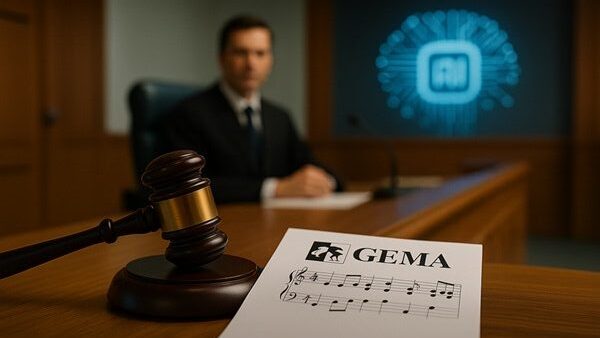
In the summer of 2024, GEMA, the German collecting society for music authors, filed a lawsuit against OpenAI at the Munich Regional Court. The subject of the dispute in the case of GEMA vs. OpenAI is the output of complete, copyright-protected song lyrics by the ChatGPT language model in response to user requests. This is done without the appropriate license. (official press release from GEMA)
These include well-known songs such as “Atemlos durch die Nacht” by Helene Fischer, “Verdammt, ich lieb’ dich” by Matthias Reim, and “Ein Stern (…der deinen Namen trägt)” by DJ Ötzi.
This makes GEMA vs. OpenAI the first known case in Europe in which a collecting society is taking legal action against an AI provider.
The subject of the dispute: unlicensed reproduction of song lyrics
GEMA represents the rights of more than 95,000 music creators in Germany, including songwriters, lyricists, and composers. In the GEMA vs. OpenAI case, GEMA alleges that ChatGPT, when prompted with requests such as:
"Please give me the lyrics to Atemlos durch die Nacht by Helene Fischer."
the complete text is published without a license agreement. OpenAI argues against this by invoking the text and data mining exception (§ 44b UrhG). This legal exception in German copyright law allows copyrighted works to be used for development purposes even without a license.
However, if the rights holders expressly object, this restriction does not apply. It allows authors to prohibit the use of their works for AI purposes—the so-called “opt-out” right. GEMA has already issued such an opt-out. In the GEMA vs. OpenAI case, they have made it clear that their works may not be used for AI training or research purposes. In GEMA’s view, OpenAI is therefore clearly infringing copyright. Further information
An overview of the key legal issues
The GEMA vs. OpenAI case shows how complex the legal situation surrounding AI and copyright has become. It also raises fundamental legal questions:
What rules apply to the use of copyrighted works by AI?
AI providers must check which content they are legally permitted to use. As a general rule, use without the consent of the rights holders is not permitted. Only if no output has been declared does the exception for text and data mining (§ 44b UrhG) apply (see above).
Does AI-generated content need to be labeled?
From August 2026, content in Germany that has been predominantly created by AI must be labeled as such. This applies in particular if the content gives the impression that it has been created by humans. Content that has merely been supported or substantially revised by AI is not subject to this labeling requirement.
Who is liable when AI models output protected content—the provider or the user?
As a rule, the provider is liable if it fails to take adequate protective measures. However, users can also be prosecuted if they publish or use material that infringes copyright.
Are AI-generated works themselves protected by copyright?
Under German law, copyright protection requires human intellectual contribution. Content created purely by AI is therefore not protected by copyright unless a human being has played a decisive role in its creation.
Status of proceedings: Judgment pending, with high expectations
The lawsuit is currently in the preparatory phase (as of early November 2025).
In the ongoing GEMA vs. OpenAI case, the presiding judge indicated that key points could be ruled in favor of GEMA. She justified this on the basis that the AI system reproduces copyright-protected song lyrics almost identically. However, OpenAI denies storing song lyrics and emphasizes that text variations and user interactions influence the results. No settlement has been reached so far.
The proceedings will continue on November 11, 2025. A ruling could then be handed down, or the case could be referred to the European Court of Justice.
At the same time, the EU Commission is examining whether AI providers will have to acquire licenses or make lump-sum payments in the future. The aim is to ensure fair remuneration for authors and to create clear rules for the use of protected content.
The case will not only decide on the use of individual song lyrics, but is also considered groundbreaking. It will clarify how copyright-protected works may be used in AI systems and whether rights holders can demand remuneration for this. The groups affected are:
- For authors: The ruling in GEMA vs. OpenAI could determine how their works are used and secure potential income.
- For AI providers: GEMA vs. OpenAI will set standards for how legally secure training data should be used and liability risks should be considered.
- Politics & regulatory authorities: The decision can serve as a basis for new laws and EU-wide regulations to create fair remuneration and clear rules.
Possible consequences of the respective judgments
- What happens if GEMA wins?
If GEMA wins, AI providers would have to pay for the use of protected works in the future. This would enable authors to enforce their rights more effectively. Such a ruling would set clear guidelines for the entire creative industry.
- What are the consequences of a ruling in favor of OpenAI?
If OpenAI wins, the use of protected works for training purposes would be largely license-free. Authors would have little right to compensation. The ruling would set a precedent for future AI systems.
Conclusion: Groundbreaking case for AI and copyright law
The legal dispute between GEMA and OpenAI marks an important turning point in the handling of copyright and artificial intelligence. It will determine the extent to which creative works may be used as training data for AI systems and which rights are protected in the process. The decision will have significant consequences for numerous creative fields. It will also show how closely law, technology, and ethics will be intertwined in the future.
Learn more about AI law and other exciting cases!